Why Bays Rarely Make a Perfect Crescent
Why bays rarely make a perfect crescent: read the mouth, back shore and uneven flanks to describe the shape you can actually see from your viewpoint.
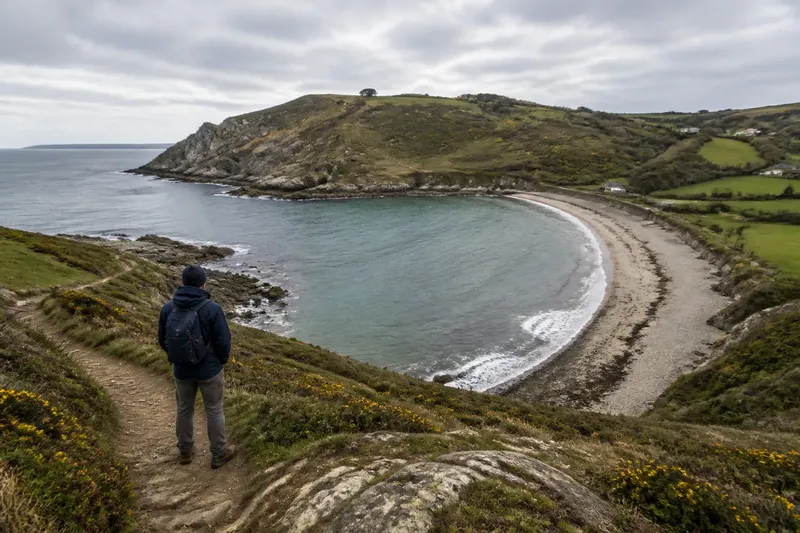
Why bays rarely make a perfect crescent is easiest to see where one side of an inlet curves inward and the other runs almost straight. The outline may reflect several local influences, such as headlands, rock ledges, shallow shelves, beaches and human alterations; no single feature explains every bay. Read the shape in front of you rather than judging it against a perfect arc.
Trace the bay from its mouth to its back shore
A bay can look rounded from a clifftop and lopsided from the beach. A projecting headland may hide a bend, and a low stretch of shore may seem to continue behind it. Your description should therefore name the viewpoint if it changes what is visible.
Find the mouth, the gap between the points or headlands that open the bay to the sea. Then follow the outline from one side, around the back shore, and out along the other side. This helps separate the overall shape from the details of a single stretch.
- If both flanks bend in broadly similar ways and the back shore rounds between them, then call it a shallow bowl; otherwise, describe the more uneven side instead of implying balance.
- If one flank curves deeply while the other stays open or nearly straight, then call it a scoop; otherwise, do not use that comparison to suggest a strong one-sided turn.
- If the mouth narrows but the back shore is long and fairly straight, then call it a pocket with a curved entrance; otherwise, describe the back shore as rounded or broken.
- If rocky points divide the edge into distinct recesses, then describe a chain of coves; otherwise, keep to the larger bay outline.
- If a near headland hides part of the opposite shore, then state that the view is partial; otherwise, describe the visible outline without implying that something is concealed.
- If the beach edge and upper shore show different lines, then say which one you are following; otherwise, use the clearest continuous boundary in view.
These comparisons are visual aids, not formal categories. Use the one that makes the outline easiest to recognise, and mention a viewpoint shift if it reveals a different section.
Choose a comparison that fits the outline
Use a shallow bowl for a balanced curve
Choose a bowl comparison when both sides turn inward in broadly similar ways and the back shore rounds between them. If a short straight stretch interrupts the curve, mention it rather than smoothing it out in your description.
Use a scoop for an uneven bay
A scoop suits a bay where one flank makes a deeper turn than the other. Name the side that bends most and note whether the back shore sits closer to one headland. This is more informative than calling the whole outline almost symmetrical.
Use a pocket for a straighter back shore
A pocket fits an inlet whose opening narrows between two points while the back shore makes a long, shallow line. Distinguish the mouth from the interior: a narrow-mouthed pocket with a straight back shore gives a clearer picture than a general crescent comparison.
Use a chain of coves for a broken edge
If small inlets and projecting points interrupt the larger outline, look for separate recesses rather than one smooth curve. Describe them as linked coves when those divisions dominate the view; otherwise, treat them as details within the larger bay.
Describe visible differences without guessing at their causes
Headlands, rock ledges, low shores and human alterations can all contribute to an uneven outline, but appearance alone does not establish which factor shaped a particular bay. You can say that a point projects farther on one side or that a shoreline turns sharply without claiming why it formed.
Orientation affects the view, too. From one side of a bay, the far shore may sit behind a point; from another, more of it may be visible. A map can show the whole outline at once, while a path or beach reveals only the sections in view from that position.
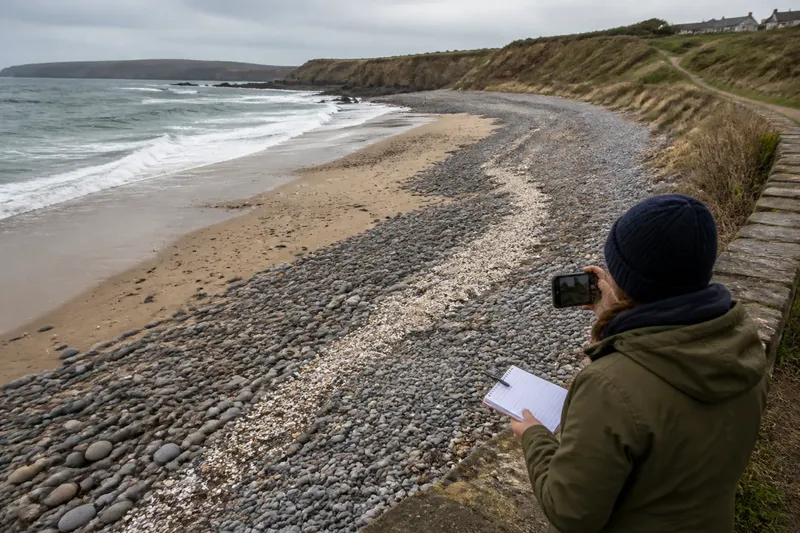
Water level and the exposed shore edge can also change which line is easiest to follow. A beach may show a pale strip beside a darker upper shore, while a rocky margin has an irregular boundary. State which edge you mean instead of treating every visible line as the same shoreline.
Which bay description fits what you can see?
Why does a bay look curved from one viewpoint but not another?
A headland or nearby shore may hide part of the outline, and the visible sections can overlap differently as you move. Name the viewpoint when that change alters the apparent shape.
What should I call a bay with one straight side?
Use a scoop or pocket comparison if it describes the curved flank and the back shore accurately. There is no need to imply that both sides have the same shape.
Can a bay be crescent-shaped if its edges are rocky?
Yes, if its larger outline forms a broad arc, even when points and recesses interrupt the edge. You can describe both scales as a crescent-like bay with an irregular rocky margin.
How can I describe a bay without a map?
Note the two points at its mouth, the deepest-looking turn and any straight or broken stretch at the back. A safe public path may reveal bends hidden from a single lookout; do not leave the path to get a better view.
Build a precise description from three observations
Say you are on a coastal path above a bay. From that viewpoint, you can see a western flank curving inward, an eastern side running almost straight to a low beach, and a headland hiding part of the far shore. Start with those observations: the western bend, the straighter eastern side and the partial view. The resulting description could be “a lopsided scoop, with a rounded western side and a straighter eastern shore; part of the far shore is hidden by the headland”. It tells a reader what is visible without claiming the hidden outline is known.
For why bays rarely make a perfect crescent, keep the description tied to the mouth, back shore, strongest change in direction and viewpoint. Skip the effort of matching the outline to a perfect geometric curve: that neatness adds little if the bay is plainly uneven. Name the visible bends, and leave their causes open unless you have evidence beyond the shape itself.