The Pebble-Size Myth: Why a Beach Is Not a Sorting Tray
Beach materials change with tide, weather and footfall. Learn how to read mixed pebbles and sand over a week without mistaking one visit for a pattern.
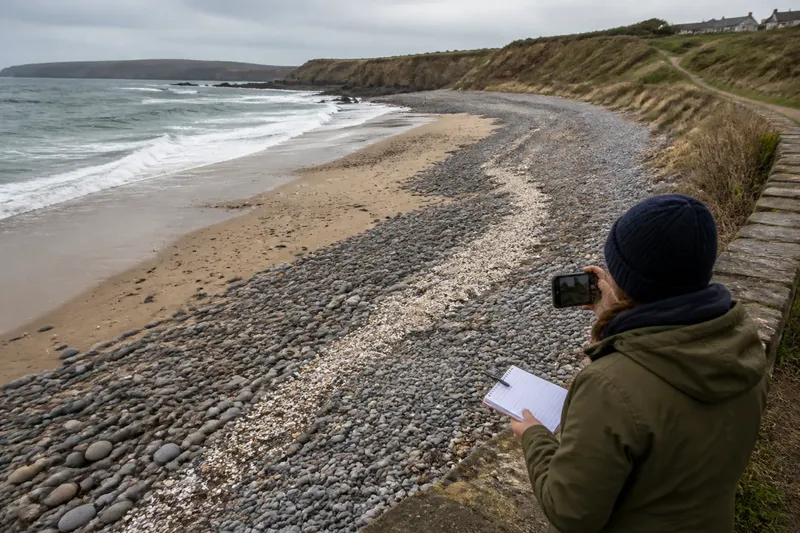
A beach materials survey can look different after one tide, even when you stand in the same place. Pebbles, sand, shell fragments and occasional larger stones do not settle into fixed size bands like objects tipped into a tray; their arrangement reflects several forces acting at once, and those forces keep changing.
A useful way to read that complexity is to revisit one short stretch over a week. You do not need to collect stones or make a formal map. A notebook, a phone camera and a steady viewpoint are enough to notice what has shifted, what remains mixed, and where a tidy-looking line may be temporary.
Beach materials mix for reasons a single visit cannot show
Waves can move fine sand readily while heavier pebbles roll or remain in place. But wave direction, water depth, the angle at which waves reach the shore, and the slope of the beach all affect which material moves and where it settles. A strong wave may carry a pebble higher up the shore, while quieter water leaves finer grains in a low area. The next tide can disturb both.
Material also differs in shape, not just size. A flat slate fragment may travel differently from a rounded stone of similar weight. Shell pieces catch and shift in ways that dense, smooth pebbles do not. Some grains lodge between larger stones; others are exposed and swept away. What appears to be a size boundary may partly reflect shape, weight, or the shelter provided by nearby material.
Local supply matters too. A small stream, eroding cliff, harbour outfall or patch of exposed bedrock can add material that is unlike the rest of the beach. A mixed patch may therefore mark a source or a sheltered pocket, rather than a stage in a neat progression from small to large.
Use a week to separate a pattern from a passing arrangement
Choose a stretch you can observe from a public path or other stable place without crossing unstable slopes or disturbing wildlife. Fix your viewpoint using something that does not move, such as a path entrance, a wall corner or a distinctive rock. Take photographs from that point, aiming at the same section of beach each time. Note the tide stage as best you can, along with visible weather and whether the sea is calm or rough.
Keep the record light enough to repeat. One observation a day is useful if conditions allow; if weather or access makes a visit unwise, skip it. The point is not to collect a complete sequence but to compare observations made under different conditions. Do not approach breaking waves, unstable cliffs or freshly deposited debris to improve a photograph.
- First visit: Record the broad mix: sand, fine gravel, pebbles, cobbles, shell and any unusual material. Note where each appears, but do not draw a sharp boundary unless it is clearly visible.
- Next calm interval: Photograph the same view and look for small-scale patterns, such as fine grains tucked between stones or a shell-rich patch beside a darker strip.
- After rough weather: Observe from a safe position. Note whether the beach face has been cut back, whether fresh material lies higher up, or whether the surface has been smoothed over.
- At a different tide stage: Compare what is exposed. A band visible at low water may be covered at high water, so apparent changes can come from visibility rather than movement.
- Final visit: Put the images side by side and mark only the changes you can see. Separate direct observations from guesses about what caused them.
Say you begin with a photograph showing a narrow strip of fine sand below rounded pebbles. After rough weather, imagine the same viewpoint shows pebbles scattered across the lower beach and shell fragments newly exposed near the path. The useful observation is that the arrangement changed; the explanation may involve wave action, water level, or material uncovered by erosion, and a week of viewing alone may not distinguish among them.
Read the beach as patches, not as a ladder of sizes
Instead of asking where the small stones end and the large ones begin, look for patches and transitions. A broad area of sand may contain isolated pebbles. A shingle ridge may have a thin veneer of finer grains. Shell fragments can cluster in a shallow hollow, while darker stones collect where water has recently drained. These combinations are not untidy exceptions to a rule; they are part of the beach’s visible structure.
Notice the edges of each patch. Is a change abrupt, like a ridge line, or gradual, with grains becoming coarser across a slope? Does the patch follow the shoreline, or does it form a local pocket behind a rock? A boundary that persists across several observations may be more informative than a single, crisp-looking band. Even then, describe what you see before assigning a cause.
Compare material on the upper beach with that near the water, but treat the comparison as a question rather than a universal rule. The upper shore may hold larger stones after waves have moved smaller grains away, yet sheltered sections can retain sand higher up. A beach’s form, exposure and nearby sources all shape the arrangement.
What can one week of beach watching tell you?
Why do large pebbles sometimes sit among fine sand?
Fine grains can settle into spaces between larger stones, especially where water movement slows or the surface offers shelter. A change in tide or wave conditions may expose that mixture without having created it during your visit.
Does a line of stones show the usual high-water mark?
It can indicate where waves deposited material under particular conditions, but one line is not a complete record of ordinary tides. Look for repeated features and compare them with the beach’s slope and recent weather before treating it as a lasting marker.
Should I pick up stones to check their size?
Usually, no: a photograph and a written description are enough for a casual observation. Leave material where it is, especially in protected areas, and follow local signs or rules about collecting.
What does a sudden change in the beach surface mean?
It shows that the visible arrangement has changed, not necessarily why. Waves, changing water level, drainage, erosion or material uncovered nearby may all contribute, so record the change without choosing a cause too quickly.
Keep observation precise and avoid false certainty
Use plain descriptions such as “sand between rounded stones” or “shell fragments concentrated in a hollow”. These are easier to compare later than labels such as “sorted” or “washed up”, which can imply a process you have not observed. If you use a phone image, include a fixed landmark in the frame and avoid editing away details that make comparisons harder.
It is not worth trying to assign every pebble a source or reconstructing a storm from a few snapshots. That effort can produce confident stories unsupported by what the beach actually reveals. A useful record distinguishes what is visible, what changed, and what remains uncertain.
Where local signs identify protected habitats or restrict access, follow them; rules and site guidance vary by place. If you notice a possible hazard such as an unstable slope or newly exposed debris, keep your distance rather than approaching to inspect it.
Let the next visit test the picture, not confirm a theory
After a week, write one sentence about the most persistent feature and one about the clearest change. Keep them separate. For example, a persistent feature might be a pebble ridge beside a sandy hollow; the change might be that the hollow was covered after rougher weather. This wording leaves room for another observation to alter your interpretation.
A beach materials survey is most useful when it resists the urge to turn a shifting surface into a perfect diagram. Return after a different tide or a spell of calmer weather, stand at the same safe viewpoint, and see whether the patchwork has settled, moved or disappeared. The beach’s mixed arrangement is not a failed sorting job; it is a record still being revised.